

Getting ready for Keyboard

Not sure what kind of keyboard to buy or what height their stool should be? It can be confusing if you've not ventured into the world of keyboard before but have no fear, we're here to help! This handy guide offers some guidance, keyboard recommendations and info to help your child prepare for their first lesson and beyond 🙂
General Information
What to Expect
Zylo keyboard lessons are a fun, relaxed way to learn how to play the keyboard, whether you're someone who's dabbled in it before or an absolute beginner.
Our focus is on ensuring that you gain an excellent understanding of the fundamentals of keyboard/piano in a supportive, enjoyable environment and develop a passion that will drive your progress.
Each session lasts 30 minutes, can accomodate up to 6 pupils and will focus on learning a particular skill or technique by learning to play melodies or chords from popular songs.
Collection and Drop-Off
Keyboard lessons take place during the school day. At first you'll be collected from your classroom by your keyboard teacher each week. Later, once you know where you're going, you may simply be reminded by your school teacher when it is time for you to go to your keyboard lesson.
You'll need to bring your keyboard book with you to lessons, so you should bring this in to school with you each week. Your keyboard teacher/school teacher will remind you to collect it on your way. We provide keyboards for everyone to use during lessons.
After your keyboard lesson, you will be taken back to your classroom or make your own way back depending on your age and the location of the lessons.
Practicing at Home
As with any instrument (or anything at all...!) practice is the key to success. The more you practice, the more comfortable and consistent your playing will become.
Regular practice helps you to master the techniques that we teach you so you can move on to learning more complex songs, discover your own style and preferences and retain what you've learned so that you never forget it.
We recommend practicing every day for at least 15 minutes. At first you may have to force yourself but after a while it will become a part of your daily routine. Sometimes practicing can be challenging or frustrating, especially if you can't quite seem to get the song right, but even when you're getting things wrong you're making progress! The best lessons are our mistakes because we learn what not to do 🙂
Required Equipment / Keyboard Advice
Only 1 thing is needed to attend Zylo keyboard lessons: a keyboard book. Links for purchasing this can be found below.
You do not need to have a keyboard or piano at home in order to attend Zylo keyboard lessons. However, we highly recommend that you get one in order to practice between lessons (and to experiment for yourself!). As such we have listed some keyboard options below to suit all budgets and spaces, along with some advice regarding choosing keyboards and accessories 🙂
Course book
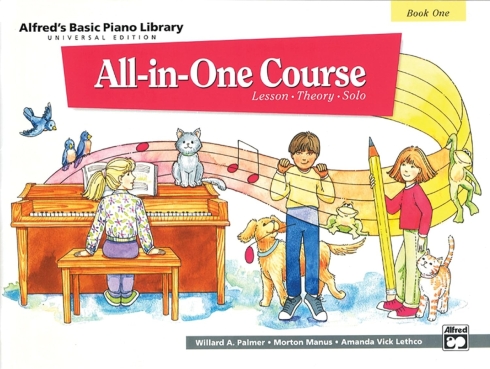
The book your child will be using during lessons is Mortun Manus's Alfred's Basic Piano Library All-In-One Course Book One. It can be purchased from the link below:
Mortun Manus is the author and editor of numerous musical education titles. In 2008, he received an honorary doctorate degree in music from the VanderCook College of Music in Chicago for his significant contribution to music education.
We love this book for it's easy to follow approach to musical notation and keyboard technique. We use it intermittently in conjunction with our own sheets and lessons built around the children's favourite songs and requests.
Weighted or Unweighted Keys?
For beginners, there is no real right or wrong when it comes to weighted key types, it is mainly down to personal preference and the desired feel. Typically instruments with weighted keys will be more expensive and though they can offer more subtle expression with volume of sound (as they are touch sensitive) this is not required or essential for a beginner.
Weighted Keys
Weighted keys aim to replicate the tactile feel of an acoustic piano keyboard, offering more pressure or resistance when pressed. The weight allows for a range of dynamics (volume) to be utilized depending on how hard a key is pressed and provides a more authentic piano playing experience, though these subtleties are not essential for beginners.
Unweighted Keys
Unweighted keys are much ‘lighter’ than their weighted counterparts with little to no resistance, requiring much less pressure on a key before a sound is produced. Generally, the sound will be the same volume no matter how hard the key is pressed. This is great for rapid playing and also beginners since the focus of learning is more on timing, coordination, and finding notes.
Semi-Weighted Keys
Semi-weighted keys provide a comfortable balance between the lightness of unweighted keys and the more substantial feel of fully weighted keys. There is a certain degree of resistance when a key is pressed, though it won’t be as heavy to the touch as fully weighted keys, which allows for tactile feedback and variation in volume to some extent, but is also very beginner friendly.
Digital Piano or Keyboard?
Digital pianos are predominantly be more expensive than keyboards as they are more substantial in size and aim to provide a closer experience to that of an acoustic piano, whilst keyboards are lighter, smaller, easier to transport and usually come with more digital features, tracks and sounds. For at home beginners, either type is suitable, so choosing comes down to personal preference and budget.
Keyboards/Electric Pianos
Keyboards will have a wider bank of instrument sounds than a digital piano, such as strings, organs and others (the exact library of sounds will vary from keyboard to keyboard). They are normally smaller and lighter than digital pianos, allowing for easier portability and storage. The keyboard stand, sustain pedal, and music stand are usually not built in, but can be bought seperately. The amount of keys is typically less than full range, but there are a variety of keyboard sizes available. The keys themselves are usually unweighted and lighter than those on a digital piano, meaning the volume will be the same no matter how hard a key is pressed. Headphones can usually be connected as standard.
Digital Pianos
Digital pianos typically try to imitate the sound and feel (and look) of an acoustic piano. They usally have a built in stand, pedals and music stand. They generally have less intrument sounds built in and focus instead on emulating the sounds of real pianos. Usually digital pianos will have a full range of 88 keys which are heavier, weighted keys, allowing for different volumes of sound to be produced depending on how hard a key is pressed, like an acoustic piano. This allows for more subtle technique and musical expression further down the road, but is not essential for beginners. Headphone connectivity may or may not be present so do be careful to check before buying.
Our Keyboard Recommendations
Below are our recommendations for beginner keyboards. We appreciate that purchasing an instrument can be expensive so we've included options to suit all budgets.
- Top recommendation 1
- Top recommendation 2
- Mid-cost recommendation 1
- Mid-cost recommendation 2
- Budget recommendation 1
- Budget recommendation 2
If you have a found a different keyboard that you're considering purchasing we are happy to offer thoughts and feedback. Just pop us an email at admin@zyloperformance.co.uk
Accessories
Keyboards generally come with an attachable music stand but other accessories can be bought separately. Though not totally essential, these other additions can enhance and improve the learning and playing experience:
Types of Accessories
A keyboard stand allows for convenient placement and height adjustment. A keyboard stool supports proper positioning and posture when playing and doesn't have arms that can get in the way. A sustain pedal broadens the range of what can be played by allowing you to sustan notes, even when they are no longer pressed down. Headphones provide privacy while practicing (and eliminate noise for everyone nearby!) and note stickers can be heplful for remembering note positions. Lastly, if you are planning on moving your keyboard around then a case is a good idea, but even if it will be left in the same place when set up a dust cover can be useful to protect the instrument from gradual wear and tear over time. Some keyboards will come with some of these accessories, so make sure to double check before ordering anything else.
Keyboard Stand and Stool
Here are our recommendations for keybopard stands and stools:
Sustain Pedal and Headphones
Here are our recommendations for sustain pedals and headphones:
Sustain Pedal
Overall recommended choice
Headphones
Top recommendation
Budget recommendation
Note Stickers, Cases and Dust Sheets
Here are our recommendations for note stickers, cases and dust sheets:
Still have a question?
If you have any additional questions about the guitar lessons, feel free to ping us an email at admin@zyloperformance.co.uk and we'll get back to you quickly.